Eye care practices don’t need more patients to have a bigger patient AR problem in 2027.
They just need patients to owe more.
Commercial healthcare costs are projected to rise sharply next year, and employers are responding by shifting more costs to employees through higher deductibles, copays, and premium contributions.
For ophthalmology and optometry practices, the impact is simple: larger patient balances will put more revenue at risk and make an already difficult collection process harder.
The Problem: Patients Will Owe More
PwC projects commercial healthcare costs will increase 9% in 2027 – the highest increase in 17 years. Segal projects an even higher median medical plan trend of 9.9%.
Nearly half of large U.S. employers say they plan to increase deductibles or copays to help offset rising costs.
That means your patient volume, procedure mix, and payer contracts could stay exactly the same, and your patient AR could still grow.
Eye care practices are particularly exposed. Patients already navigate medical insurance, vision benefits, deductibles, coinsurance, surgical procedures, and patient-paid options such as premium IOLs and refractive upgrades.
As patient responsibility grows, the way practices manage those balances becomes increasingly important.
The Old Patient Billing Model Wasn’t Built for This
Most practices know the cycle:
Send a statement. Wait. Send another. Make a call. Leave a voicemail. Repeat.
The problem isn’t simply that this process is slow. It’s that it requires staff to do work that modern technology can automate while giving every patient a better billing experience.
As balances increase, that model becomes even more expensive and hard to manage.
Your billing team doesn’t suddenly have more capacity because patients owe more. Instead, larger balances move through the same statement cycles and manual workflows, putting more revenue at risk as accounts age. In addition, high patient balances mean more patient phone calls and questions.
Higher patient responsibility requires a more modern way to manage patient AR.
The Solution: Modernize the Entire Patient Billing Process with AI-first Patient Financial Engagement
Raxia replaces fragmented, manual patient billing processes with an AI-powered platform that manages the entire patient AR journey—from billing and outreach to patient calls and chats through payment.
Instead of relying primarily on statements and staff follow-up, Raxia automates the process and uses patient data and behavior to create a more personalized financial experience and can answer patient questions via the phone or chat.
That includes:
- AI-powered patient engagement that determines how and when patients are most likely to respond
- Automated text and email outreach that continuously moves balances toward resolution
- Interactive digital bills that make balances easier to understand and act on
- Self-service payments, payment plans, and stored payment options that let patients resolve balances without calling the practice
- AI-powered billing support through chat and voice that answers common patient questions without adding to staff call volume
- Automated workflows and payment posting that reduce administrative work for billing teams
- Integrated patient AR data and reporting that gives practices visibility into outreach, payments, aging, and performance
Rather than asking staff to work harder as patient balances increase, Raxia automates more of the work and makes each patient interaction more relevant, convenient, and actionable.
The result is a patient billing process that can scale as patient responsibility grows.
What This Looks Like in an Eye Care Practice
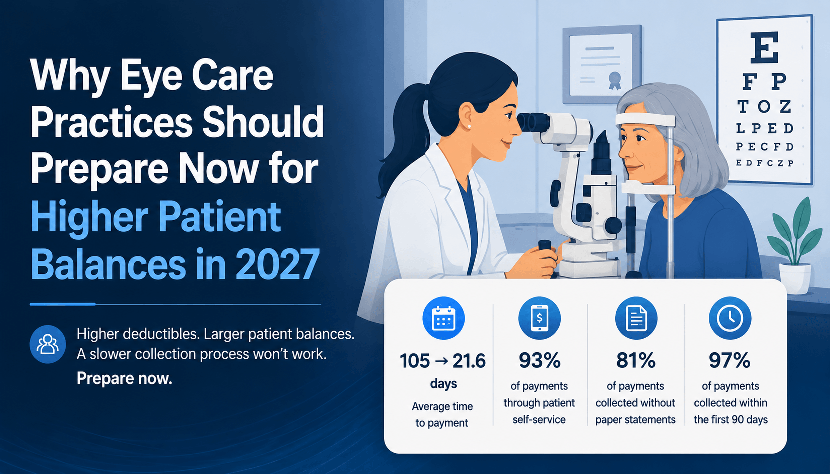
One ophthalmology and optometry group moved from a traditional patient collection process to Raxia’s AI-powered YourHealthBill platform.
The results:
105 to 21.6 days
Average time to payment
93%
of payments completed through patient self-service
81%
of payments collected without sending a paper statement
97%
of payments collected within the first 90 days
84 NPS
demonstrating that automation can improve financial performance while still delivering a strong patient experience
These results were achieved before the expected increase in patient financial responsibility in 2027.
That’s what makes them especially important.
As patient balances grow, practices that can automate engagement, personalize outreach, answer questions with AI, and enable patients to resolve balances themselves will be in a much stronger position than practices trying to manage the increase with additional statements and staff follow-up.
Prepare Your Patient Billing Strategy for 2027
You can’t control healthcare cost increases or how much of those costs employers and insurers shift to patients.
You can control whether your patient billing process is ready for it.
Raxia gives eye care practices a modern, AI-powered way to manage patient AR, automating billing workflows, personalizing patient engagement, expanding self-service, reducing staff effort, and helping patients resolve balances faster.
As patient responsibility increases, those capabilities become more valuable.