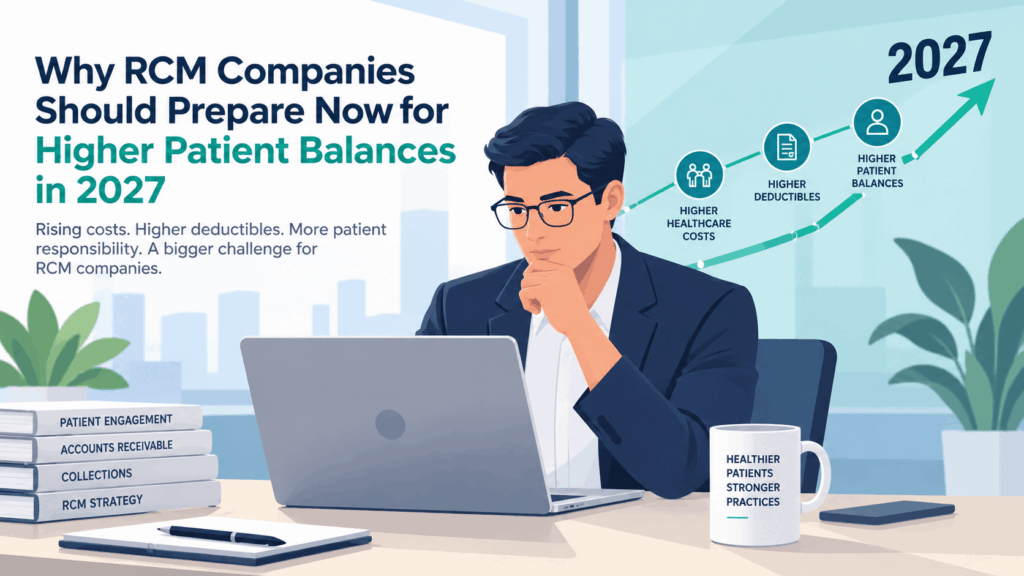
Your RCM company doesn’t need more clients, more encounters, or more claims to have a bigger patient AR problem in 2027.
Patients just need to owe more. And every reliable forecast says they will.
The Problem: Patients Will Owe More
Commercial healthcare costs are heading for their steepest increase in nearly two decades, and employers have already said how they plan to respond: by shifting more of the cost to employees.
- PwC projects a 9% commercial group medical cost trend for 2027, the highest in 17 years.
- Mercer projects employer health benefit costs will rise 8.2% per employee in 2027, the largest increase since 2003. 59% of employers plan cost-cutting changes to their health benefits next year, including higher deductibles.
- Nearly half (48%) of large employers expect to change their medical plans for 2027 in ways that raise employees’ out-of-pocket costs, such as higher deductibles or copays. About two-thirds expect to raise the employee share of premiums.
The mechanics are simple. Higher deductibles and copays move dollars from the payer column to the patient column. Your clients’ volume, payer mix, and contracts can stay exactly the same, and a larger share of every dollar you’re responsible for collecting will come from patients instead of payers.
Why This Hits RCM Companies Harder Than It Hits Practices
For the RCM companies we work with, patient AR is already one of the most expensive parts of the revenue cycle to manage. Payer AR benefits from clearinghouses, ERAs, and purpose-built automation. Patient AR is often managed through a mix of paper statements, phone calls, and digital tools built into individual PM systems.
Many RCM companies already send texts, emails, and e-statements. The problem is that these tools are often disconnected across different PM systems and rely on standardized, one-size-fits-all outreach. They were built to send billing communications, not to optimize patient engagement and collections.
That cost structure creates three problems when patient balances grow:
Margin compression. Most RCM contracts are priced as a percentage of collections. That percentage doesn’t change when the collection mix shifts from payer to patient. Your blended cost to collect goes up while your fee stays flat.
Patient collection costs scale with balances, not with revenue. More patient responsibility can mean more outreach, more statements, more billing questions, and more staff involvement per client, whether or not the balance is ultimately paid.
Client scrutiny. Your clients see patient AR aging in the reports you send them. When 90+ day patient AR grows in 2027, they will read it as an RCM performance problem, not a benefit design problem. Client retention conversations will get harder.
Traditional Digital Billing Isn’t Enough
The challenge isn’t that RCM companies aren’t using digital tools. Many are.
The challenge is that patient billing is often fragmented across the different PM systems used by their clients. One system sends an e-statement. Another sends a text. Another sends an email. Each may have its own portal, payment experience, outreach cadence, and reporting.
And much of that outreach follows the same basic logic: send the same message to every patient on the same schedule and wait for them to respond.
That’s digital billing, but it isn’t optimized patient engagement.
As patient balances increase, simply sending more reminders through disconnected systems won’t solve the problem. Larger balances require an approach designed to understand how patients engage, make it easier for them to take action, and move more payments earlier in the AR cycle.
The answer isn’t simply more statements, more texts, more emails, or more collectors.
It’s better patient engagement that collects earlier.
The Solution: Stop Balances From Becoming Aging AR
The RCM companies best positioned for 2027 will reach patients the moment a balance becomes their responsibility and actively optimize the path from balance notification to payment.
AI-powered, digital-first patient engagement makes that possible across an entire client base by:
- Reaching patients quickly through personalized text and email
- Personalizing outreach based on patient behavior and engagement
- Making bills easy to understand and pay from a phone
- Providing self-service payments and payment plans
Patient balances are about to grow — is your collection strategy ready?
Talk to our team about building a digital-first patient engagement approach before 2027 hits.