Every EHR and practice management system will tell you it handles patient billing. And technically, it does.
It can generate statements, send e-statements, and give patients a portal to make a payment.
But sending a bill and collecting a balance are two very different things.
Provider collection rates on commercially insured patient balances fell to 47.6% in 2023 and have not recovered. At the same time, patients are responsible for more of their healthcare costs than ever.
The problem isn’t that practices aren’t sending enough bills. It’s that the systems they rely on were never designed to actively engage patients and drive payment.
EHR and PM systems built for billing workflows, not patient behavior
EHR and PM systems are essential clinical and operational platforms. But their patient billing tools are typically built around internal workflows: balance finalization, batch cycles, statement runs, and portals.
That creates three fundamental problems.
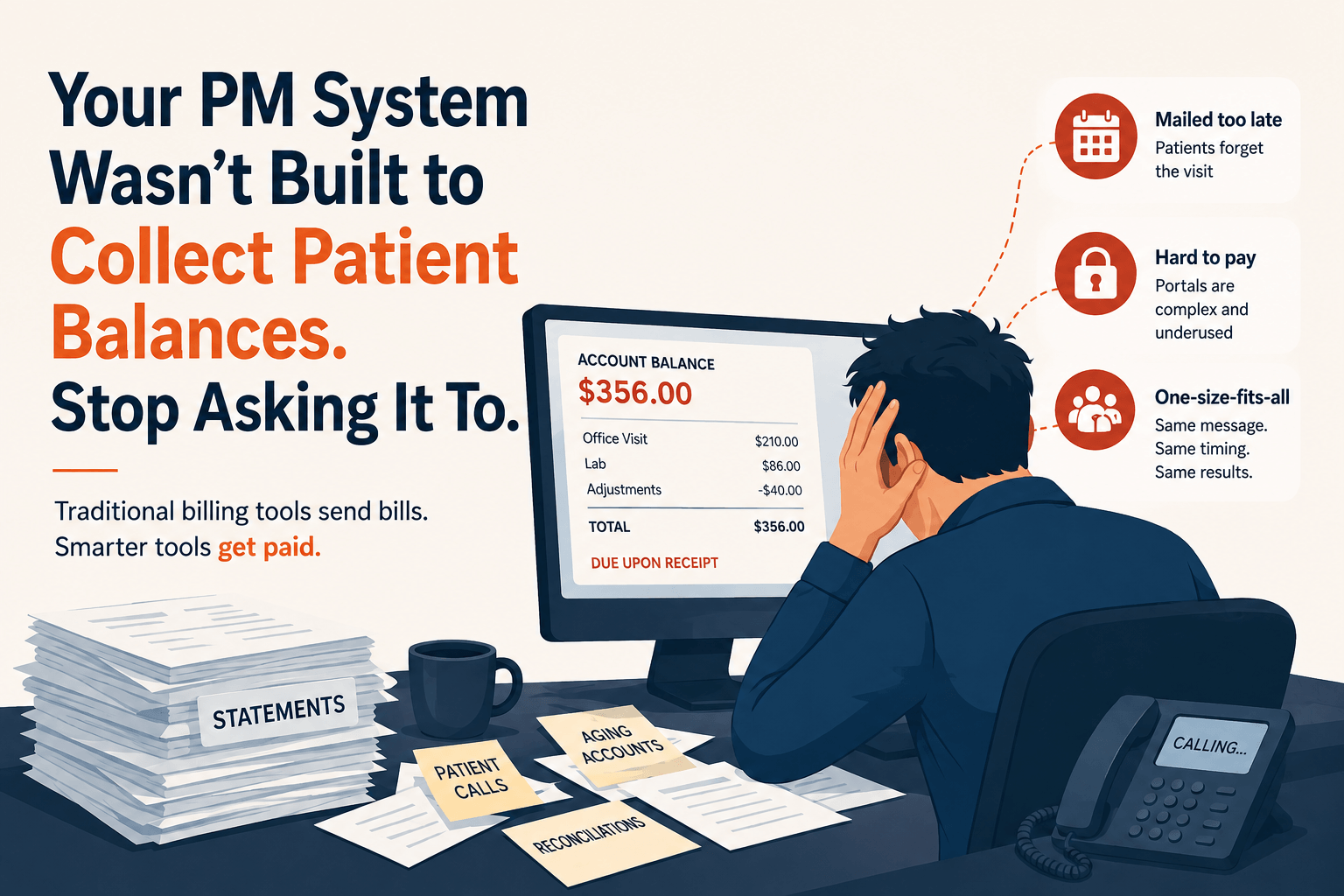
- Billing starts too late. A balance may sit until the next statement cycle before the patient hears anything. By then, they may barely remember the visit, or even recognize the provider sending the bill.
- Digital often means “log into the portal.” Patients who pay nearly everything else from a text or email are asked to remember a password, navigate a clinical portal, find their balance, and figure out how to pay it.
- Every patient gets essentially the same treatment. Same statement cycle. Same cadence. Same channels. The system doesn’t learn who responds to text versus email, when they’re most likely to pay, or when additional outreach is unlikely to work.
That’s bill delivery. It’s not a collections strategy.
The cost isn’t just unpaid balances
When the technology can’t manage the patient journey, staff have to.
They answer billing calls. Run statement batches. Reconcile payments. Track aging accounts. Explain confusing balances. Follow up manually.
And RCM teams often respond to weak collections by doing more of the same: send another statement, make another call, add more staff time.
There is a better model.
Make every patient interaction smarter
Modern patient collections shouldn’t treat every patient the same. AI and behavioral data can personalize the billing journey based on how each patient is most likely to respond.
Instead of sending everyone the same reminders on the same schedule, AI can determine when to reach out, which channel to use, and what message is most likely to drive action, then adapt future outreach based on how the patient responds.
Combine that intelligence with a simple digital bill patients can understand and pay in seconds, without a portal login, and patient billing becomes far more effective.
More patients engage. More balances get paid. And fewer accounts require statements, phone calls, or staff intervention.
An Anesthesiology Group
Increased collections from 61% to 86%, with 74% of payments arriving within 30 days.
A Behavioral Health Organization
Reduced average time to payment from 110 days to 22 days, with 79% of payments completed through self-service.
An Orthopedic Group
Increased balances paid within 60 days from 21% to 71% while reducing statement costs by 71%.
The pattern is consistent:
More collections. Faster payments. Fewer statements. Fewer calls. Less manual work.
For RCM companies, the problem is even bigger.
RCM companies don’t have one PM system to deal with. They may have dozens.
Each has different statement workflows, portals, payment tools, and posting processes. That forces teams to manage patient AR differently for every client and makes one of the most labor-intensive parts of the revenue cycle difficult to scale.
The alternative is to put a single patient financial engagement layer across those systems, one that standardizes outreach, payments, self-service, and automation regardless of the underlying PM system.
One RCM company operating across seven EHR/PM systems reduced patient billing costs 80% while increasing payment rates 33% within 90 days.
That’s when patient AR stops being a cost center and starts becoming a margin opportunity.
Your PM system should run your practice. It doesn’t have to run patient collections.
Your EHR or PM system is essential infrastructure. But that doesn’t mean its built-in billing module is the best tool for collecting patient balances.
“We sent the statement” is no longer enough.
Raxia connects to 70+ PM systems and uses behavioral data to determine who to engage, when to engage them, and how they’re most likely to respond—text, email, or other channels. Patients receive a simple digital bill they can understand and pay in seconds, without a portal login.
The result: customers typically see 20–40% higher patient collections, up to 85% fewer paper statements, and significant reductions in billing calls and manual AR work.
If your patient collections have plateaued, sending more statements probably isn’t the answer.
It may be time to stop asking your PM system to do a job it wasn’t built to do.
If your collection rate has stalled, the fix probably isn't another statement cycle.
Let’s look at where patients are dropping off in your current billing journey — and what a behavior-driven approach could change.